-
-
011- 69313821

011- 69313821
An SOP for MBA is more than just a formality. In 2025, over 250,000 students worldwide are expected to apply for MBA programs. According to GMAC, India accounts for nearly one-third of global GMAT test-takers this year.
Top Universities like Harvard, Stanford, and INSEAD have an average applicant-to-seat ratio of 10 to 1. With that level of competition, a strong SOP can be the difference between getting shortlisted or rejected.
This blog explains how to write an impactful SOP for MBA, what to include, what to avoid, and how to tailor it for specific B-schools.
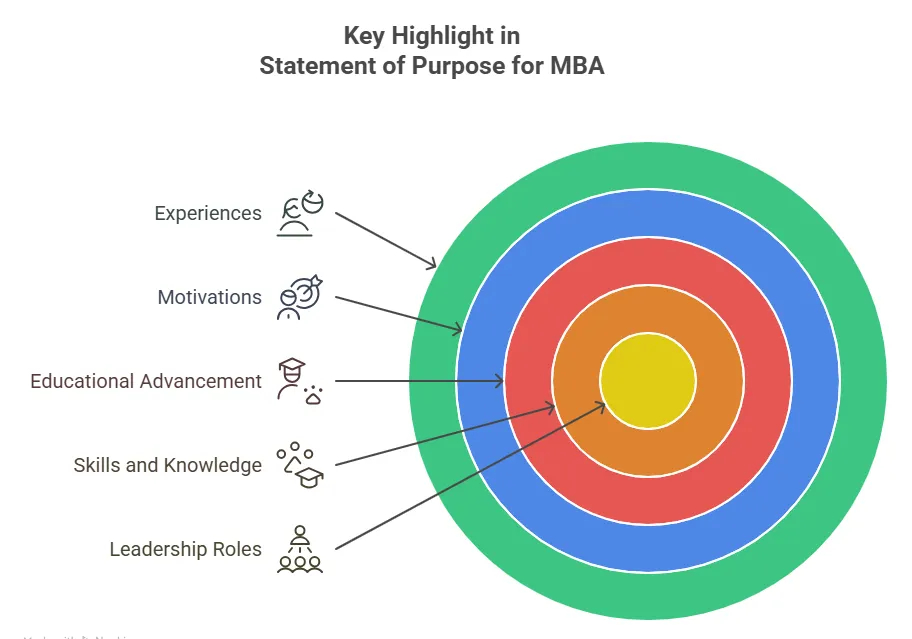
A strong MBA SOP explains your career path, justifies why you need an MBA, and proves why you’re a good fit for the program. Schools want to see clear goals, leadership skills, and industry impact.
| Section | Purpose | What to Include? |
|---|---|---|
| Introduction | Hook the reader | A real challenge or experience that led you to pursue an MBA. |
| Academic & Work Background | Show expertise | Your education, career progression, leadership roles, and impact. |
| Why an MBA & Why Now? | Justify your decision | Skill gaps, career shift, or business goals requiring an MBA. |
| Why This University? | Show fit with the school | Courses, faculty, alumni network, or specialization relevant to your goals. |
| Career Goals | Define short & long-term plans | Where you see yourself post-MBA and how the program helps you get there. |
| Conclusion | Reinforce your commitment | Your contribution to the MBA cohort and long-term vision. |
88% of business schools say SOPs help evaluate leadership potential and decision-making skills (GMAC, 2023).
Over 90% of top MBA programs expect candidates to demonstrate career clarity in their SOP (Financial Times, 2023).
Open with a real experience that shaped your career decisions. Avoid generic statements like “I have always been passionate about business.” Use a specific challenge or success to introduce your MBA goal.
"I want to grow in my career, so I need an MBA." "At Infosys, I led a supply chain optimization project that reduced costs by 18%. While I improved operational efficiency, I realized I lacked formal training in strategic planning. An MBA will help me bridge this gap and transition into a leadership role in operations management."
Mention your degree, coursework, or projects relevant to business. If you don’t have a business degree, explain how your background relates to an MBA. Highlight leadership roles in college, competitions, or volunteering.
| What to Highlight? | How to Present It? |
|---|---|
| Relevant Degree | "Graduated in Mechanical Engineering from IIT Bombay with a focus on efficiency and process automation." |
| Leadership in College | "Led a 20-member team in a national business challenge, securing first place for a market expansion plan." |
| Relevant Coursework | "Completed certification courses in financial modeling and business strategy to prepare for an MBA in Finance." |
A GMAC report (2023) found that 74% of top business schools look for candidates who demonstrated leadership before their MBA.
For MBA applicants with an engineering background, read SOP for MBA with Engineering Background.
Show career progression, responsibilities, and major accomplishments. Use numbers to prove your impact. Highlight instances where you made a real difference in your company.
| Career Achievement | How to Present It in Your SOP? |
|---|---|
| Revenue Growth | "At HDFC Bank, I introduced a digital lending model that increased loan approvals by 20%." |
| Process Improvement | "Redesigned logistics at Flipkart, cutting supply chain costs by 18%." |
| Product Launch | "Managed the launch of a fintech app that acquired 50,000 users within three months." |
88% of successful MBA applicants mention measurable career impact in their SOPs (Financial Times, 2023).
Mention specific courses, faculty, or networking opportunities that fit your career goals. Show how this MBA is the right fit for your career growth. Avoid generic statements like “This university is well known.”
"I want to study at ISB because it has a strong reputation." "ISB’s Digital Transformation course will help me refine my skills in business analytics, a crucial area for my transition into data-driven decision-making in supply chain management."
30-40% of MBA SOPs are rejected for failing to mention university-specific details (GMAC, 2023).
Clearly define your short-term and long-term goals.
Show how this MBA fills the gap between your experience and future plans.
"Post-MBA, I aim to transition into a strategy consultant role in a global consulting firm. In the long run, I see myself leading operations for an international logistics company, ensuring supply chain efficiency through technology-driven solutions. The MBA at INSEAD, with its focus on global strategy and operations, will help me develop the necessary expertise and industry connections."
Over 90% of top business schools expect applicants to have a well-defined post-MBA career plan.
Summarize why an MBA is the next logical step.
Show enthusiasm for the program and how you will contribute to the MBA community.
"With my experience in operations and process optimization, an MBA at LBS will give me the strategic knowledge and leadership training needed to expand my impact on global supply chain management. I look forward to collaborating with peers and contributing to discussions on business innovation."
Nearly 40% of MBA students come from non-business backgrounds (GMAC, 2023). Many engineers, doctors, and creative professionals transition into business leadership roles through an MBA.
McKinsey, BCG, and Bain recruit over 30% of their new hires from engineering and science backgrounds after they complete an MBA (McKinsey Hiring Report, 2023)
A career switch isn’t a problem, but a weak explanation is. Your SOP should clearly show:
What led to the switch? A specific moment, challenge, or realization that made you rethink your career path.
What skills carry over? Leadership, problem-solving, or strategic thinking from your previous role.
Why an MBA is necessary? What business skills you lack and how the program will fill those gaps.
| Previous Industry | How It Relates to Business | Example |
|---|---|---|
| Engineering | Data analysis, project management, cost optimization | "At L&T, I redesigned a supply chain system, cutting costs by 18%. Now, I need an MBA to develop end-to-end supply chain strategy skills." |
| Healthcare | Process efficiency, resource management, team leadership | "As a doctor, I streamlined patient flow in a hospital, reducing wait times by 30%. An MBA in Healthcare Management will help me scale these improvements at an industry level." |
| Arts & Media | Consumer behavior, brand storytelling, communication strategy | "As a journalist, I analyzed audience trends to boost engagement. An MBA in Marketing will allow me to apply these skills in brand positioning and market research." |
"While working as a software engineer at Infosys, I managed a fintech project that increased transaction speed by 20%. However, I struggled with pricing models and market expansion strategies, areas outside my technical expertise. To transition into product management, I need an MBA with a focus on digital transformation and business strategy. ISB’s strong industry connections and case-based learning will help me refine these skills and bridge the gap between technology and business."
A low GPA or test score doesn’t define your potential. Top business schools look at your entire profile—work experience, leadership, and impact matter just as much. Harvard Business School admits applicants with GPAs as low as 2.8 if they show strong career impact, leadership, and innovation (HBS Admissions, 2023).
If your numbers are below average, acknowledge it, but don’t dwell on it. Instead, shift the focus to:
Your career growth – Promotions, leadership roles, major contributions at work.
Relevant skills – Technical, financial, or strategic skills gained through experience.
Extra learning efforts – Certifications, online courses, or GMAT retakes that show commitment.
| Issue | How to Frame It Positively? |
|---|---|
| Low GPA in Early Semesters | "I struggled with adjusting to the academic load in my first year, but I improved my GPA in later semesters while leading a student-run consulting club." |
| Weak GMAT Quant Score | "While my GMAT quant score is below average, my experience as a financial analyst at Deloitte involved complex financial modeling, demonstrating my strong quantitative skills." |
| Overall GPA Below Class Average | "Although my GPA was lower than my peers, my work at Amazon, where I optimized logistics and reduced delays by 22%, proves my ability to handle data-driven decision-making in real-world scenarios." |
Harvard Business School admits candidates with GPAs as low as 2.8 if they show exceptional leadership and career achievements (HBS Admissions, 2023).
"My first year at IIT Delhi was a challenge. Adjusting to the intense academic load, I struggled to balance coursework and extracurricular commitments. However, by my second year, I found my rhythm—earning top grades in business-related electives and leading the Entrepreneurship Cell, which launched two successful student ventures. More importantly, my professional experience at McKinsey, where I led a digital transformation project for a Fortune 500 client, showcases my ability to thrive in high-pressure business environments—skills that matter most for an MBA at Wharton."
Not all MBA applicants have full-time work experience, and that’s okay. Top business schools like ISB, INSEAD, and LBS admit candidates with strong academic backgrounds, leadership roles, and relevant internships. In fact, ISB’s 2023 MBA batch had nearly 30% of students with less than two years of experience. Your SOP should prove that you have the skills, mindset, and potential to thrive in a business environment.
| Activity | How to Present It in Your SOP? |
|---|---|
| Student Leadership | "As President of the Finance Club at SRCC, I led a team of 30 to organize India’s largest student stock trading competition." |
| Case Competitions | "Won 1st place in the IIM Ahmedabad Business Challenge, designing an expansion strategy for an FMCG brand." |
| Internships | "During my summer internship at PwC, I assisted in a cost-reduction analysis that saved the client ₹3 crore annually." |
| Entrepreneurial Projects | "Launched a student-run e-commerce store that generated ₹5 lakh in revenue within six months." |
40% of INSEAD’s MBA class in 2023 had no full-time work experience but demonstrated strong leadership and problem-solving skills (INSEAD Admissions Report, 2023).
"During my final year at IIT Bombay, I co-led a consulting project that helped a small manufacturer improve inventory management, reducing waste by 15%. This experience made me realize the power of strategic decision-making. However, I lacked structured financial and leadership training. To transition into strategy consulting, I need an MBA from ISB, which offers hands-on consulting projects and mentorship from industry leaders. With my background in analytics and problem-solving, I aim to develop a strong foundation in business decision-making through an MBA."
If you have 3+ years of experience, your SOP should demonstrate leadership, measurable impact, and problem-solving ability. Business schools look for candidates who have taken initiative, driven change, and delivered results.
ISB’s 2023 MBA batch had an average work experience of 4.5 years, with 68% of students coming from consulting, technology, and finance backgrounds.
Highlight leadership and business impact.
| Activity | How to Present It in Your SOP? |
|---|---|
| Student Leadership | "As President of the Finance Club at SRCC, I led a team of 30 to organize India’s largest student stock trading competition." |
| Case Competitions | "Won 1st place in the IIM Ahmedabad Business Challenge, designing an expansion strategy for an FMCG brand." |
| Internships | "During my summer internship at PwC, I assisted in a cost-reduction analysis that saved the client ₹3 crore annually." |
| Entrepreneurial Projects | "Launched a student-run e-commerce store that generated ₹5 lakh in revenue within six months." |
90% of top MBA programs prefer candidates who quantify their business impact rather than just listing job roles (Financial Times, 2023).
Using bullet points in an SOP is not recommended. Admissions committees expect a well-structured narrative, not a list. Focus on storytelling, clarity, and flow to demonstrate your goals, background, and motivation instead of breaking format with bullets.
Yes, an SOP for MBA should be in the first person. It allows you to present your personal experiences and aspirations authentically. Avoid overusing “I” in every sentence, but maintain a consistent and reflective first-person voice.
Tie your work experience to your MBA goals. Highlight relevant roles, achievements, or skills that align with your desired specialization. Show how past responsibilities shaped your perspective and prepared you for the challenges of a management degree.
Be as specific as possible with your career goals. Instead of saying you want to work in finance, mention your aim to become a financial analyst at an investment firm. Clear goals reflect direction and purpose, which MBA committees highly value.
Yes, but only if you explain them constructively. Briefly address low grades and focus on what you learned or how you improved afterward. Don’t make excuses, admissions teams appreciate honesty, growth, and resilience over perfection.
Most top B-schools limit SOPs to around 500–1,000 words. Always check the specific word count guidelines of each university. Going under or over the limit can signal a lack of attention to detail, which may hurt your application.
Yes, but with caution. Tools like ChatGPT can help you brainstorm and structure your SOP, but avoid copying generic content. Admission panels can detect AI-written statements. Always personalise your SOP to reflect your real journey and voice.