-
-
011- 69313821

011- 69313821
Update: In 2025, over 350 Indian students got their fee completely waived off in USA Universities. These students got the prestigious Fulbright-Nehru Scholarship covering all expenses – tuition fees, living expenses, airfare and health insurance.
Study abroad in developed countries like USA, Canada, Germany, Australia, UK has become more and more expensive in recent years. High quality of education, life standards and income makes living in those countries very expensive, especially students from countries like India. For an example, the average cost of studying (including living and other expenses) in UK, can fall anywhere between £15,000 - £40,000 which translates to approximately 17.8L – 47.4L annually. Study abroad for free or in affordable prices can be an alternate for getting same quality of education in much lower prices.
Countries like Germany and Nordic countries like Norway, Denmark, Sweden and Iceland provide affordable or free education to its students and international students. Some public universities like TU Munich, University of Oslo or University of Vienna offer free or affordable studies to their students. Scholarships also have a great support in cutting down expenses with top scholarships including Fulbright-Nehru Scholarship (USA), Chevening (UK), Erasmus+ (EU) and DAAD (Germany).
This guide will walk you through the key pathways for achieving a tuition-free global education. You’ll get to know Fully funded scholarships and tuition-free countries with best programs for Indian students. With motivated effort and smart planning, the dream to study abroad free for Indian students is very much alive and we're here to help you navigate it.
The possibility of studying abroad without paying huge tuition fees is not an exclusive privilege of a few lucky ones - it is possible 2025 and 2026. Global opportunities are on the increase with increasing universities in Europe moving towards tuition-free policies, government initiating new scholarship schemes, and exchange schemes deepening their penetration. To Indian students, this is a bonus as toddlerhood brings a bigger opportunity to access world-class education at minimal or no expense.
The best plans are to make use of scholarships, no tuition universities and government-sponsored programs not only to eliminate the cost factor but to increase cultural and academic exposure. Studying abroad on a free basis is an option and is possible with early planning and the proper mindset.
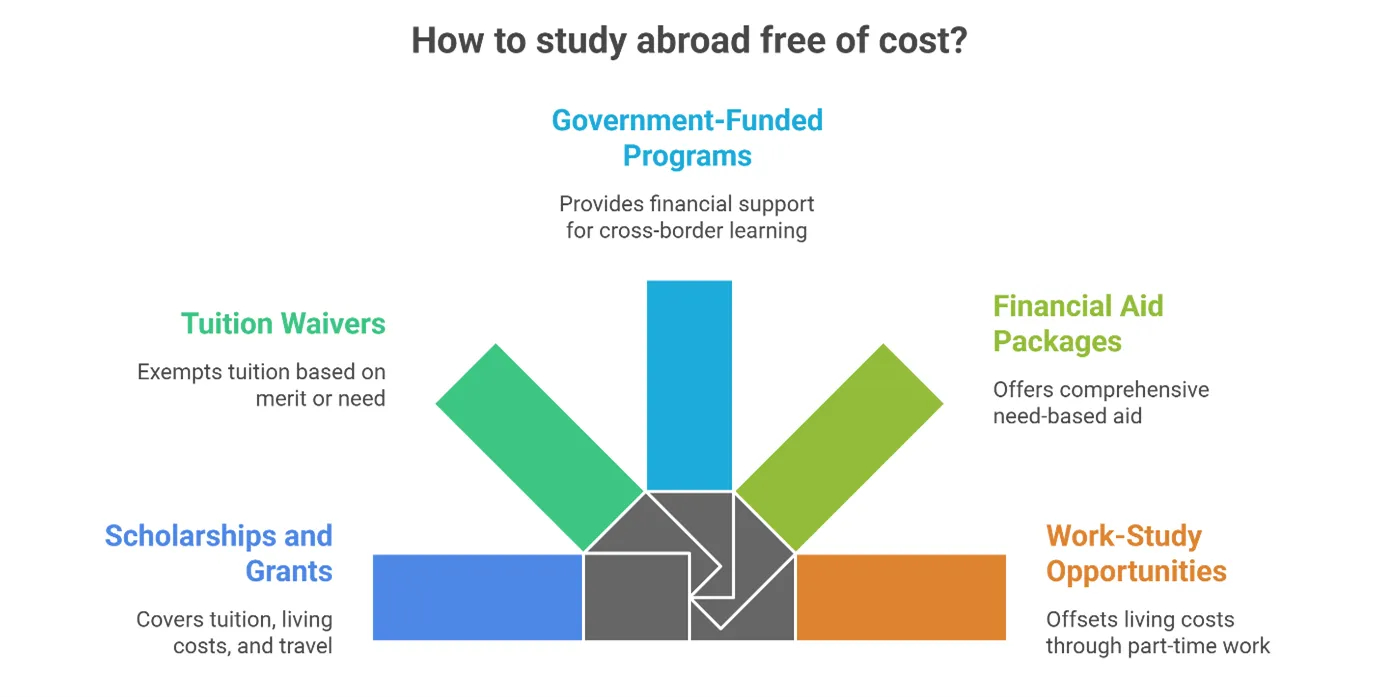
Students generally rely on four broad categories when it comes to free or highly subsidized international education:
Together, these routes make studying abroad free or highly affordable a reality for thousands of students each year.
Scholarships are one of the strongest routes to study abroad for free and in 2025–2026, several fully funded options are available for deserving students. These scholarships don’t just waive tuition; they also cover living expenses, travel, and sometimes research costs. While eligibility criteria vary, most require strong academic records, English proficiency, and leadership or community involvement. Below are some of the most prestigious international scholarships Indian students can apply for.
| Scholarship | Eligibility (Short) | Coverage Highlights |
|---|---|---|
| Fulbright-Nehru (USA) | Indian citizenship, UG degree, 3+ years work/academic experience | Tuition, living costs, airfare, health insurance |
| Chevening (UK) | Bachelor’s degree, 2+ years work experience, leadership potential | Full tuition, living allowance, airfare |
| DAAD (Germany) | UG degree, academic excellence, language proficiency (German/English) | Tuition-free study, stipends, research grants |
| Erasmus Mundus (EU) | UG degree, admission into joint master’s program, strong academics | Tuition, travel, insurance, stipend |
| Commonwealth (UK) | Indian citizenship, UG degree, academic merit + need-based | Tuition, airfare, living costs, thesis grants |
Several top-ranked universities abroad offer free or low-cost education to international students, including those from India. Most of these are public universities in Europe - funded by governments that believe in making education accessible. Alongside tuition-free policies many universities also extend scholarships, grants and tuition-waivers to help students cover living costs.
Studying at these institutions ensures not just affordability but also exposure to high-quality education, strong research facilities and global career opportunities. Below is a list of leading tuition-free or low-cost universities you should explore in 2025–26.
| University | QS World Ranking (2026) | Key Opportunity Offered |
|---|---|---|
| Technical University of Munich (Germany) | =22 | Tuition-free for all students, small semester fee only |
| University of Oslo (Norway) | =119 | 100% tuition-free across all levels |
| University of Vienna (Austria) | 152 | Very low tuition fees (€1,500/year approx.) |
| Sorbonne University (France) | 72 | Subsidized tuition, scholarships for international students |
| Aalto University (Finland) | 114 | Full/partial scholarships covering tuition & living |
| Heidelberg University (Germany) | 80 | Tuition-free public education, DAAD scholarships available |
| University of Bergen (Norway) | =287 | Tuition-free, opportunities for Erasmus+ exchange |
| Paris-Saclay University (France) | =70 | Affordable tuition, Eiffel & Charpak scholarships for Indians |
Many countries have made higher education either tuition-free or highly affordable especially in Europe. For Indian students, this is a huge advantage as they can access world-class degrees while paying only minimal semester contributions or living costs. Countries like Germany and Norway are well known for completely free tuition at public universities, while others such as Austria, Finland and France charge nominal fees.
Several governments also provide scholarships to international students to further cut down expenses. The key is to check eligibility requirements, which often include academic performance, language proficiency and in some cases proof of financial stability.
Popular tuition-free or affordable countries include:
Germany is the leading destination for students seeking tuition-free higher education. Public universities charge no tuition fees, and students only need to pay a semester contribution of €250–€400 for administrative costs and transportation. The quality of education, combined with research opportunities and strong scholarships, makes Germany top choice for international students.
Norway is another country where international students including Indians, can study for free. Public universities do not charge tuition fees at any level (bachelor’s, master’s or PhD). Only semester fees of 500-1000 NOK are charged which is around INR 4400 – 8800. However, study in Norway for free is not completely free as only study fee or university fee is exempted only. Students should be prepared for relatively high living costs in cities like Oslo or Bergen.
Most tuition-free opportunities cover academic expenses but not always the living costs such as rent, food, and personal needs. Fully funded scholarships like Erasmus+ or DAAD may include monthly stipends, health insurance, and accommodation support. However, in many cases, students must rely on part-time jobs, assistantships, or personal savings to meet daily living expenses abroad.
Some of the most common courses for 100% scholarships abroad include STEM fields like Computer Science, Engineering, Medicine, and Data Science, along with Economics, Public Policy, and International Relations. Fully funded programs usually focus on courses with global demand, research potential, or societal contribution. Humanities also receive funding under cultural exchange scholarships like Erasmus+.
Eligibility for fully funded scholarships depends on academic merit, standardized test scores, extracurricular achievements, and leadership potential. Most scholarships also require strong Statements of Purpose (SOPs), Letters of Recommendation (LORs), and sometimes proof of financial need. Additionally, meeting country-specific language requirements and submitting applications before deadlines increases your chances of securing a fully funded offer.
Chances vary depending on your academic profile, destination country, and scholarship applied for. Countries like Germany, Norway, and Austria already offer free or low-cost education, while global scholarships like Chevening, Fulbright, and DAAD are highly competitive but achievable with proper preparation. Indian students with strong grades, test scores, and extracurricular activities have realistic chances of success.
Most US universities charge high tuition, but some top institutions like Harvard, MIT, or Yale offer full-ride scholarships that cover tuition, accommodation, and living expenses. These are highly competitive and usually awarded based on academic excellence and leadership potential. Need-based financial aid is also available for international students at Ivy League and top private universities.
Requirements usually include excellent academic records, proof of language proficiency (IELTS/TOEFL for English or TestDaF for German), and supporting documents like transcripts, SOPs, and LORs. Some programs may ask for entrance exams or prior research experience. Free universities in Europe and Nordic countries expect students to maintain strong grades throughout their studies to retain benefits.
With 80% marks, you can qualify for several merit-based scholarships such as DAAD (Germany), Erasmus+ (Europe), and some partial funding options in Canada or the UK. While fully funded scholarships may require higher academic performance or additional achievements, strong applications with extracurriculars and leadership records can still help secure partial or full funding opportunities.