-
-
011- 69313821

011- 69313821
Studying abroad offers Indian students a unique set of career and personal growth opportunities that are becoming increasingly valuable in 2026. Research by HSBC found that international students can expect to earn 17% more than their peers who did not study abroad.
Studying in countries such as Canada and Australia not only offers world-class education but also clear pathways to Permanent Residency (PR), allowing students to build long-term careers abroad. This blog explores the top 12 advantages of studying abroad in 2026, with insights to help you make an informed choice about your future.
The exposure to international work environments and the opportunity to develop skills highly valued by employers globally can open doors to higher-paying and more prestigious jobs. 64% of employers think that international experience is important for recruitment.
Looking to earn a globally recognized degree in less time? Explore 1-year Master’s programs in the UK designed for Indian students seeking accelerated academic and career growth.
Studying abroad is more than academics; it’s an opportunity to form lifelong friendships with people worldwide. These connections can be both personal and professional, giving you access to networks that might otherwise be unavailable.
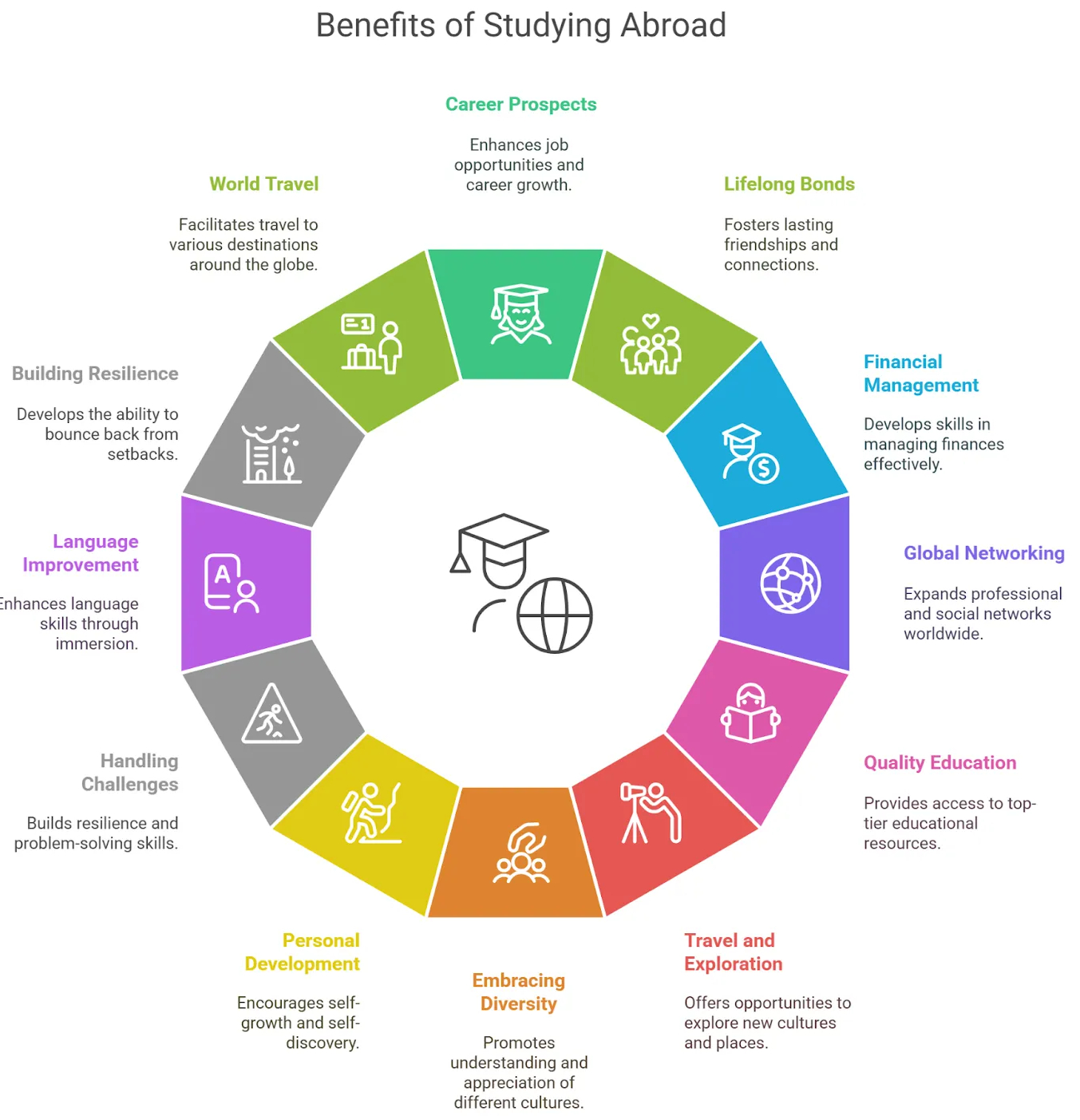
When you study abroad, you are forced to manage your finances independently, an important skill for your future. Learning to budget effectively and manage currency exchange rates will enhance your financial responsibility and discipline.
Networking abroad opens doors to a world of career opportunities and connections. You’ll meet professionals, professors, and peers from various industries, building international relations that can help you later on, whether you want to work abroad or find global clients.
International universities offer a level of education often superior to that locally available. Whether it’s the opportunity to work with world-renowned professors or access the latest research and technologies, studying abroad can give you an academic edge.
One of the most exciting aspects of studying abroad is the opportunity to travel and experience new cultures. Whether it’s exploring Europe during semester breaks or weekend trips to nearby countries, studying abroad allows you to expand your horizons.
Studying abroad encourages a greater appreciation for diversity. You will interact with people from all walks of life, gaining a deeper understanding of the importance of inclusivity and cultural awareness, skills highly valued in any global career.
Living abroad can be a transformative experience. The challenges you face, whether academic, social, or logistical, help you grow as an individual, enhancing your resilience, independence, and self-confidence.
With all its advantages, studying abroad also comes with challenges, be it language barriers, homesickness, or adjusting to a new education system. Overcoming these obstacles helps you develop resilience and critical thinking skills crucial for long-term success.
Studying abroad is an immersive way to master a new language. Being surrounded by native speakers in an academic setting accelerates language learning and helps you achieve fluency faster.
Studying abroad requires students to step outside their comfort zones, whether managing academic expectations or handling personal issues in an unfamiliar environment. This process builds emotional resilience and prepares students to face life's challenges head-on.
Studying abroad not only allows you to get an education but also gives you the freedom to explore new places. The convenience of being based in a different country makes it easier to explore nearby regions during breaks or long weekends.
As of 2026, the QS World University Rankings highlight several institutions renowned for their academic excellence and global impact. The Massachusetts Institute of Technology (MIT) holds the top position globally.
Other prominent universities include Imperial College London and the University of Cambridge. These universities offer exceptional personal and professional growth, with diverse programs to suit various academic interests.
The table below shows the top 15 universities in the QS World University Rankings:
| Rank | University | Location | QS Score |
|---|---|---|---|
| 1 | Massachusetts Institute of Technology (MIT) | Cambridge, USA | 100 |
| 2 | Imperial College London | London, UK | 98.5 |
| 3 | University of Oxford | Oxford, UK | 96.9 |
| 4 | Harvard University | Cambridge, USA | 96.8 |
| 5 | University of Cambridge | Cambridge, UK | 96.7 |
| 6 | Stanford University | Stanford, USA | 96.5 |
| 7 | ETH Zurich | Zurich, Switzerland | 96.3 |
| 8 | National University of Singapore (NUS) | Singapore | 96.2 |
| 9 | California Institute of Technology (Caltech) | Pasadena, USA | 96.0 |
| 10 | University College London (UCL) | London, UK | 95.8 |
| 11 | University of Chicago | Chicago, USA | 95.6 |
| 12 | Princeton University | Princeton, USA | 95.4 |
| 13 | University of Melbourne | Melbourne, Australia | 95.2 |
| 14 | University of Sydney | Sydney, Australia | 95.0 |
| 15 | University of California, Berkeley | Berkeley, USA | 94.8 |
Now that you know the advantages of studying abroad, let's look at some top universities worldwide that offer exceptional opportunities for international students.
Yes, international graduates are often seen as more attractive due to their ability to adapt to diverse environments, work across cultures, and demonstrate independence. In fact, 64% of employers think that international experience is important for recruitment.
Studying abroad hones skills like cultural adaptability, global networking, and independent problem-solving. For example, learning to figure out and excel in a new academic system or living with people from different cultures can teach you resilience and global collaboration skills that are rare in local education systems.
Yes, culture shock is common, but it's a powerful learning experience. It challenges your comfort zone, uplifts your emotional intelligence, and strengthens your adaptability, skills crucial for both personal growth and professional success in a global job market.
While a good degree at home is valuable, studying abroad offers a global perspective that is hard to replicate locally. You gain exposure to different teaching methods, international networks, and career opportunities that can give you an edge in the global job market.
Absolutely. While teaching styles may differ, international universities provide support like orientation programs, mentorships, and peer networks to help you adjust. Many students find that diverse teaching methods enhance their learning and critical thinking skills.
With technology today, staying in touch is easier than ever. Apps like WhatsApp, Skype, and Zoom make it simple to connect with family and friends, whether it's through video calls or messaging, keeping you connected despite the distance.
Not necessarily. Many countries, especially in Europe and the US, offer programs in English. However, knowing the basics of the local language can help you understand daily life better, enrich your experience, and show respect for the culture you're in.